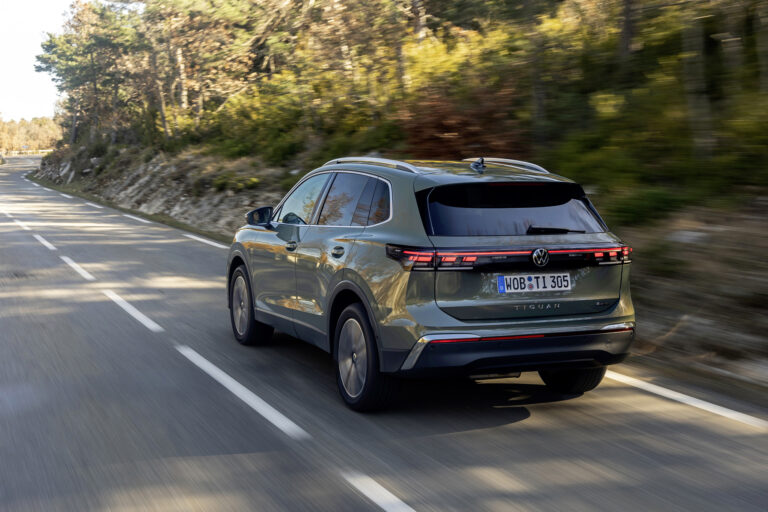
DSG faults in the Tiguan are often recognised by jolting, vibrations, delayed gear changes or the sudden loss of gears. In the Volkswagen Tiguan, the cause depends heavily on which DSG type is fitted. Changing the oil can help where maintenance has been neglected, but it will not fix a faulty sensor or worn clutch. Complaints that only occur once the gearbox is warm, in particular, call for a focused diagnosis. What should you look out for before agreeing to a repair?
Which DSG problems occur in the Tiguan?
A Tiguan with DSG may pull away jerkily, change gear harshly, or hesitate briefly before engaging D or R. Vibrations when reversing and shunting after a gear change can also occur. Do you notice the issue mainly in city traffic, when manoeuvring, or under heavy load? Then note exactly when it happens. Those conditions help a specialist distinguish between problems with the clutch, the control system and hydraulic pressure.
The following signs deserve immediate attention:
- The gearbox only changes into even or only into odd gears.
- Reverse gear disappears or only engages after a delay.
- The revs rise, but the car barely accelerates.
- A warning appears about the gearbox, or the car goes into limp mode.
A DSG uses two clutches to control different groups of gears. If the control of one clutch fails, an entire group of gears can disappear. According to the technical information in the supplied information document, a missing reverse gear and limp mode also fit with mechatronic problems. That is the unit that controls the electronic and hydraulic actuation for the clutches and gear changes.
‘ Therefore, have the transmission code checked before a garage quotes a service interval or orders parts. ’
The DSG type determines where to look
Not every Tiguan has the same transmission. Second-generation models can feature the DQ381 and DQ500, among others; other variants may have a DQ250 or DQ200. Engine, year and trim determine which gearbox is actually fitted. So have the transmission code checked before a garage quotes a service interval or orders parts.
This difference matters when it comes to oil. Wet DSG clutches run in oil and, depending on the version, require oil and filter maintenance in line with Volkswagen’s schedule. A dry DSG variant has a different maintenance regime. So do not assume one oil-change interval applies to all Tiguans, even if they have the same number of gears.

Symptoms of a faulty DSG in the Tiguan Allspace
The same complaints are relevant for a Tiguan Allspace with DSG: vibration when pulling away, a delayed response to the accelerator pedal and jolts during slow manoeuvring. Also watch for a warning that only appears after a longer drive. A gearbox may shift normally when cold and then go into limp mode when warm. That pattern is valuable information for diagnosis, not proof that the entire transmission needs replacing.
With some DQ381 and DQ500 complaints, a loss of hydraulic pressure is cited as a possible cause. When the oil warms up, an existing pressure problem can become more noticeable. The clutch may then no longer be controlled steadily, resulting in slip or shifting faults. Have such a complaint assessed while the transmission is warm; a short drive around the garage may miss the fault.
Does the warning disappear after switching off the engine? Do not take that as a repair. A restart may temporarily clear limp mode while the underlying cause remains. Note how many minutes it takes for the fault to return and whether it happens in stop-start traffic, during acceleration or when towing a trailer.
Fault codes point the way, but prove little
A DSG-specific diagnostic tool can show more than a basic OBD reader. In the fault memory you may find, for example, P173500 and P173600, codes relating to the clutch position sensors. P175E indicates that clutch 1 is closing unexpectedly. Such a code gives a direction for the search, but on its own it does not prove that the whole mechatronic unit is faulty.
A sensible diagnosis proceeds in this order:
- Read out the transmission control unit and save the fault codes together with the conditions under which they occurred.
- During a test drive, check the temperature, clutch position, slip and available pressure values.
- Inspect the power supply, earths, connectors and wiring for breaks or poor connections.
- Check the oil level, oil quality and service history in line with the instructions for the gearbox in question.
- Only then examine the clutch, mechatronics and dual-mass flywheel for wear or damage.
Do not clear fault codes straight away. Doing so may remove data that shows how often the fault occurred and under what conditions. Also ask the garage which measured value supports the proposed repair. That way you avoid replacing a part on the basis of a warning light alone.
‘ Do not expect fresh oil to repair a broken sensor, leaking hydraulics or a worn clutch. ’
When does changing the oil help with DSG complaints?
Proper maintenance can limit contamination and wear. If the oil change is overdue according to the service schedule, replacing it with the specified oil is a logical step. At the same time, have the filter replaced if Volkswagen specifies this for the transmission in question. Setting the oil level at the correct temperature is also part of the job.
Do not expect fresh oil to repair a broken sensor, leaking hydraulics or a worn clutch. If there is already slipping, limp mode or missing gears, first find out what is going wrong. If the vehicle has been serviced before, ask for the invoice: that lets you check which oil was used and whether the filter was included.
How much does it cost to repair a DSG in the Tiguan?
There is no reliable fixed price for a DSG repair on a Tiguan. Repairing a connector or wiring is very different from overhauling the mechatronics. If the clutch and dual-mass flywheel also need replacing, the parts and labour costs rise further. Without a diagnosis and transmission code, a concrete price would be little more than false reassurance.
So ask for a quotation in which the following items are listed separately:
- Diagnosis and the evidence for the fault identified.
- New or reconditioned parts, including warranty terms.
- Oil, filter, fitting and any software coding.
- Basic settings and a test drive to check shift behaviour.
A reconditioned mechatronic unit is an alternative to a complete new unit, provided a specialist can identify the faulty part and test the repair. If the clutch is clearly worn, reconditioning the mechatronics will not solve that. If in doubt, ask for a second diagnosis before the gearbox is removed.
Check a used Tiguan when it is warm too
During a test drive, do not just drive round the block. Test gentle pulling away, stop-start traffic, reversing and brisk acceleration once the car is warm. Watch for a delay when selecting D or R and ask for invoices for DSG maintenance. If in doubt, have the transmission control unit read out as well, not just the engine.
Want to look beyond the gearbox? On the Carnews website you can find more about Tiguan problems, maintenance and other car topics. Discover which points are relevant to your version.
Frequently asked questions
What are the technical differences between the ‘dry’ DQ200 and ‘wet’ DQ250 or DQ500 ‘DSG’ transmissions in the Volkswagen Tiguan in terms of thermal load?
The 7-speed DQ200 has dry clutches without oil-bath cooling, which means that under slip—such as in stop-start traffic, creeping, on hills or when towing—heat builds up locally in the clutch plates and thermal limits or wear occur more quickly. The DQ250 and DQ500 use wet multi-plate clutches, whose oil carries heat away to the transmission housing and oil cooler, so they tolerate prolonged slip and higher torque better. In return, there are extra pump and friction losses and thermal stress on the oil, which is why it must be changed periodically together with the filter. Thanks to its more robust clutches and greater cooling and oil capacity, the DQ500 generally has the highest thermal reserve.
Which specific symptoms indicate multiple ‘mechatronic’ failures in ‘DSG’ gearboxes in later generations of the Tiguan?
In later Tiguan generations, limp mode, the loss of either the even or the odd gears, and a missing reverse gear indicate mechatronic failure. Other signs are harsh, delayed or jerky shifting, slip and transmission warnings. A hallmark is that the complaints occur when the DSG is warm and temporarily disappear after a restart. Fault codes P173500, P173600 and P175E strengthen the suspicion of defective clutch position sensors or hydraulic control.
To what extent does software calibration affect the service life and shift precision of dual-clutch transmissions under heavy load?
Software calibration influences clutch pressure, engagement timing, permitted slip and thermal protection, and therefore plays a major role in shift precision and wear under heavy load. Correct calibration limits slip and heat build-up, whereas an incorrect or poorly adapted setting can cause jolts, delayed shifting, overheating and accelerated wear. Software can therefore noticeably support service life, but it cannot repair a worn clutch, faulty sensor or hydraulic pressure loss.
What are the symptoms of wear in the dual-mass flywheels within the DSG drivetrain of all-wheel-drive Tiguan models?
Wear in the dual-mass flywheel shows up mainly as a rattling or knocking noise at idle. Vibrations and jolts can also occur when pulling away, reversing or changing gear. These complaints can resemble clutch or DSG problems, which is why a mechanical inspection is needed.