
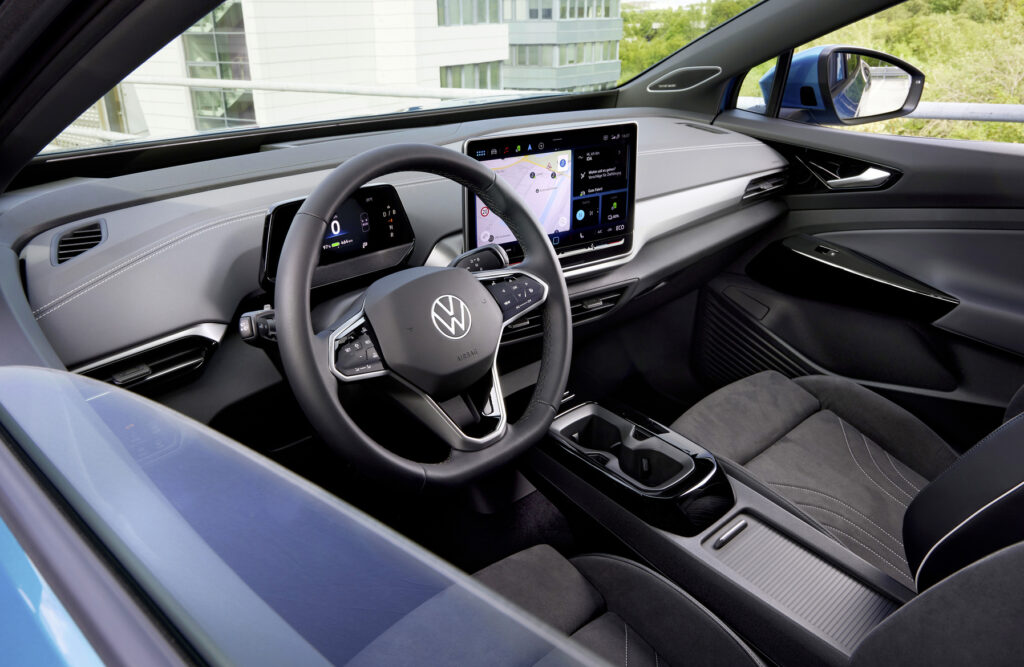
In everyday use, the Volkswagen ID.4 delivers a range of around 240 to 400 kilometres, significantly less than the official WLTP figure of 529 kilometres. This real-world driving range is reduced even further when you tow a trailer, with the range potentially halving. The electric SUV is often considered for family use or occasional light transport jobs. It is useful to know what you can realistically expect in terms of energy consumption and range from the ID.4.
What is the real range of the ID.4?
The official specifications from Volkswagen promise a range between 325 and 529 kilometres, depending on the battery version. The ID.4 is available with three battery capacities: 52 kWh (Pure), 77 kWh (Pro/Life) and 82 kWh. In practice, owners average 19.3 kWh per 100 kilometres. This means roughly 398 kilometres from the 77 kWh battery.
The real-world range varies greatly depending on the type of journey. At a speed of 100 kilometres per hour, the Volkswagen ID.4 uses on average 20.9 kWh per 100 kilometres, which gives a range of 368 kilometres. If you drive at 130 kilometres per hour on the motorway, consumption rises to 29.8 kWh per 100 kilometres. The range then drops to just 258 kilometres. This explains why many owners report that in real life they get between 240 and 350 kilometres on motorways.
In urban traffic and at lower speeds, the ID.4 performs considerably better. In summer conditions without air conditioning, owners report figures as low as 16 kWh per 100 kilometres. You can then cover up to 481 kilometres. However, these figures are rarely seen in everyday use, where mixed driving and fluctuating temperatures are the norm.
‘ This significantly limits the practicality of the ID.4. ’
How does a trailer affect the ID.4’s range?
Towing a trailer has a drastic effect on the ID.4’s energy consumption. Owners report that the range with a light trailer within the maximum towing capacity can drop sharply, to less than half of the normal value. Where you might still get 350 to 400 kilometres in mixed traffic without a trailer, this can drop to around 150 to 200 kilometres with a trailer.
This sharp drop is caused by several factors. The extra mass increases rolling resistance, while the poorer aerodynamics cause energy consumption at higher speeds to rise considerably. On motorway journeys with a trailer, consumption quickly rises to 35 to 40 kWh per 100 kilometres. Longer journeys with a trailer therefore become practically difficult. You have to charge more often and carefully plan every charging stop.
Some families regularly use a caravan or trailer. This significantly limits the practicality of the ID.4. You must take into account frequent charging stops, which can lengthen your journey time. Plan your route in advance, including suitable fast-charging stations. Also adjust your expectations for daily distances.

Impact of winter conditions on range
Cold winter months further increase energy consumption. Suppose the temperature is around -10 degrees Celsius and you are using the cabin heater. The range then drops to 240 to 375 kilometres. Consumption can rise to 26 kWh per 100 kilometres, which means a loss of about 23 percent compared with summer conditions.
Battery heating uses energy, as does heating the cabin. Cabin heating uses an average of 2 kW. Owners report that driving gently helps. Using seat heating instead of heating the entire cabin also saves energy. With a cautious driving style, the range remains around 376 kilometres, even in winter.
How can you increase the ID.4’s range?
A few practical adjustments can improve your ID.4’s range. The most important factor is your driving style. Limit your speed on the motorway to a maximum of 100 kilometres per hour. You will then achieve a range of 368 kilometres. At 130 kilometres per hour that drops to just 258 kilometres. Avoid heavy acceleration and use regenerative braking consistently to recover energy.
Choose eco mode, which optimises the power output and climate control for efficiency. In cold weather, it is wise to preheat the car while it is still plugged into the charger. You then set off with a warm battery and cabin, without using valuable energy from the battery. This can partly prevent the 20 to 25 percent winter loss.
Other tips for increasing range:
- Check tyre pressures regularly. Correctly inflated tyres reduce consumption by 1 to 2 kWh per 100 kilometres.
- Travel light and remove unnecessary luggage. A roof rack or fully loaded boot increases consumption by 10 to 15 percent.
- Use seat heating instead of heating the entire cabin, as this requires significantly less energy
- Plan routes with fast-charging stations and charge en route to a maximum of 80 percent. With the standard 125 kW charging capacity, this takes 27 minutes.
‘ For the time being, the technology is less suitable for regular use with a caravan or heavy load over longer distances. ’
Comparison with other electric SUVs
The ID.4 performs reasonably well within its class. However, there are electric SUVs with a longer range. The Tesla Model Y Long Range often achieves 450 to 500 kilometres in real-world use, thanks to a larger battery and a more efficient drivetrain. The Hyundai Ioniq 5 with a 77.4 kWh battery also offers a similar or slightly better range under the same conditions.
Some buyers specifically look for maximum range when towing trailers. At the moment, there are few electric SUVs that truly excel in this area. All electric vehicles experience a substantial loss of range when towing. For the time being, the technology is less suitable for regular use with a caravan or heavy load over longer distances.

Real-world experiences from owners
Owners generally praise the ID.4 for its stable consumption in mixed driving. Figures fall between 17 and 19 kWh per 100 kilometres. Daily commuting and short trips rarely cause problems. A range of 350 to 400 kilometres is then a realistic expectation. Regenerative braking works well and helps to recover energy in town driving.
The main complaints concern motorway consumption above 120 kilometres per hour. Winter performance is also disappointing. At sub-zero temperatures and on longer motorway journeys, owners have to adjust their expectations. The CCS fast-charging network (rapid chargers using the standard CCS connector type) generally works well, but planning for longer trips with a trailer requires extra attention.
Many drivers share their experiences on forums. Small adjustments in driving behaviour make a noticeable difference. Using eco mode consciously can add dozens of kilometres per trip. Anticipatory driving also helps, as does using the climate control intelligently.
Everyday practicality
Many families use the ID.4 mainly for daily journeys within a radius of 150 kilometres. The range is then more than adequate. You can charge at home and are rarely dependent on public charging infrastructure. The spacious interior and solid finish make the car suitable for family use. Do bear in mind the limitations on longer journeys.
Regular holiday travel with a trailer is challenging. Weekly journeys of more than 300 kilometres also require extra planning. You will have to charge en route, and the reduced range at higher speeds plays a part. This demands more planning than with a comparable combustion-engine car. Most people in the Netherlands mainly drive short and medium-length trips. For this average driving pattern, the ID.4 is a good fit.
On the Carnews website you can find more information about electric cars and maintenance advice. There you will also find practical experiences with various models. Discover which electric SUV best matches your driving style and needs.
Frequently asked questions
The ID.4’s WLTP figure (up to around 517–529 km for the 77 kWh version) is clearly higher than the realistic range in everyday use. In mixed driving, many drivers achieve around 350–400 km, depending on temperature and driving style. On the motorway, range drops to roughly 350 km at 120 km/h and even down towards 260 km at 130 km/h. In severe winter conditions, range can fall further to roughly 240–375 km.
In everyday use, the ID.4’s energy consumption and range are mainly influenced by driving speed (especially sustained 120–130 km/h on the motorway) and driving style (hard acceleration, little anticipation). In addition, outside temperature and use of climate control/heating have a major impact, particularly in winter. Vehicle load and aerodynamics, such as extra weight and roof boxes, also increase consumption noticeably. Finally, tyre pressure and tyre type/size play a role: too low a pressure and wide or “heavy” tyres increase consumption.
In terms of energy efficiency, the Volkswagen ID.4 scores average to good within the electric SUV segment, with an official WLTP consumption starting at around 14.6–15 kWh/100 km for the most efficient versions. In real-world mixed driving it often comes out at around 17–20 kWh/100 km, which is comparable to, or slightly better than, many competing, heavier or more powerful electric SUVs. At higher motorway speeds and in cold conditions, consumption does rise noticeably, as it does for its rivals. As a result, the ID.4 does not belong to the absolute top tier of the most efficient EVs, but as a spacious SUV it sits in the better part of the middle of the pack.
Large temperature differences, especially cold, increase the battery’s energy consumption and can reduce the ID.4’s range by roughly 20–25% compared with ideal conditions. In winter, warming up the battery and interior costs extra energy, so you get fewer kilometres from a full charge. Using climate control (particularly heating) has a clearly negative impact on range; air conditioning in summer uses less energy than heating in winter, but still reduces the range. By using heating more sparingly (for example seat and steering wheel heating, preconditioning while plugged in), you can keep the range as high as possible.
The ID.4’s range increases significantly with a calm, steady driving style at moderate speeds (around 100 km/h), while avoiding hard acceleration and high speeds. Ideally, use eco driving mode and make active use of regenerative braking. Also limit the use of climate control (heating/air conditioning), use seat heating and precondition the car while it is plugged in. Finally, ensure correct tyre pressures and avoid unnecessary extra weight and roof racks.