
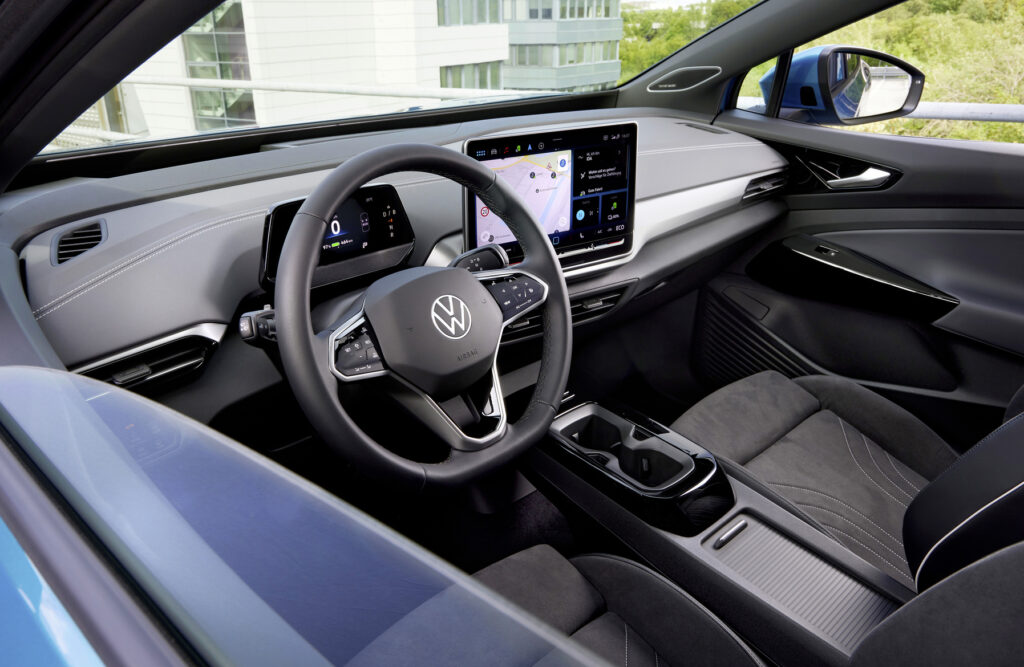
The Volkswagen ID.4 has different tyre sizes front and rear, which rules out conventional tyre rotation. This leads to uneven wear and means owners have to replace the rear tyres prematurely, resulting in higher maintenance costs and logistical headaches. Why did Volkswagen choose this system and what are the consequences for your wallet?
Why can ID.4 tyres not be rotated?
The Volkswagen ID.4 comes as standard with different tyre sizes on the front and rear axle. The front tyres are usually 235/55 R19, while the rear tyres measure 255/50 R19. This configuration makes it physically impossible to swap tyres following the classic rotation pattern.
Volkswagen chose these staggered tyre sizes to optimise driving characteristics. The wider rear tyres offer more grip and stability, which contributes to the handling of this electric SUV model. The extra weight of the battery in the underside of the car calls for this reinforced traction at the rear.
For owners this means a fundamentally different maintenance approach. Tyre rotation, normally carried out to distribute wear evenly across all four tyres, is completely off the table. You are limited to checking and replacing front and rear tyres separately based on actual wear.
‘ Owners report that rear tyres sometimes have to be replaced after just 25,000 to 35,000 kilometres, while front tyres often last 50,000 kilometres or more. ’
Do the ID.4’s rear tyres wear faster?
Yes, several owners report that the rear tyres of the ID.4 wear out significantly faster than the front tyres. This is due to the drivetrain configuration of the model. Most ID.4 variants have rear-wheel drive, where the rear axle has to handle all the power and torque.
The high torque of electric motors amplifies this effect. During acceleration, all traction is transferred to the road surface via the rear tyres, leading to increased wear. This process accelerates especially with sporty driving or frequent city trips with lots of stop-and-go traffic.
Owners report that rear tyres sometimes have to be replaced after just 25,000 to 35,000 kilometres, while front tyres often last 50,000 kilometres or more. This unequal lifespan makes predictable maintenance planning more difficult and increases the frequency of visits to the workshop. The AWD version of the ID.4 distributes power across both axles, which results in more even tyre wear. Even there, however, rotation remains impossible due to the different sizes.
What tyre sizes does the ID.4 have?
The Volkswagen ID.4 has various tyre combinations, depending on trim level and model year. The most common configuration combines 235/55 R19 front tyres with 255/50 R19 rear tyres. These sizes are standard on many Pro and Pro Performance versions.
Some entry-level versions have a uniform tyre size of 235/60 R18 all round. With this configuration tyre rotation is possible, which makes maintenance considerably easier. Always check the specifications of your exact model before making assumptions about maintenance schedules.
You can find the correct tyre sizes in several places:
- On the sticker in the driver’s side door frame
- In the vehicle’s owner’s manual
- On the sidewall of your current tyres, where the size is indicated
- In the Volkswagen app or online owner information
Note that winter tyres must also comply with these specific sizes. You cannot simply switch to uniform sizes without affecting handling and safety.
How much do replacement tyres for the ID.4 cost?
The cost of new ID.4 tyres depends on brand, quality and season. For the 235/55 R19 front tyres you can expect prices between 120 and 200 euros per tyre. The wider 255/50 R19 rear tyres are usually higher, between 140 and 220 euros each.
Because you have to replace the rear tyres earlier, you are faced with an irregular replacement pattern. Replacing a set of rear tyres, including fitting, balancing and any disposal charges, will quickly cost 350 to 500 euros. Replacement of the front tyres will then follow later for similar amounts.
Over a distance of 100,000 kilometres you will on average replace the rear tyres twice and the front tyres once. This brings total tyre costs to around 1,200 to 1,500 euros, excluding any winter tyres. By comparison, on a car with uniform tyre sizes and regular rotation, costs are often 20 to 30 per cent lower due to the longer lifespan per tyre.
‘ The ID.4 has a built-in tyre pressure monitoring system, but manual checks remain the most reliable. ’
Practical tips for ID.4 tyre management
Monitor tyre pressure regularly, at least once a month. Correct pressure significantly extends tyre life and prevents uneven wear. The ID.4 has a built-in tyre pressure monitoring system, but manual checks remain the most reliable.
Have tyre pressure and tread depth checked at every service. Ask the workshop specifically to look at the differences between front and rear tyres. This way you can plan replacement moments better and avoid being surprised by tyres being rejected during the MOT.
Consider replacing rear tyres in pairs, even if only one tyre is approaching the minimum tread depth. This prevents differences in grip between left and right, which benefits stability. Some owners opt for slightly harder tyre compounds at the rear. This extends lifespan, but may come at the expense of comfort.
Plan your budgets in advance. Be aware that rear tyre replacement is a recurring item that does not coincide with replacement of the front tyres. This makes financial planning easier and prevents unexpected expenses.

Alternatives and solutions
If you are buying a new ID.4, check whether the version you are considering comes as standard with uniform tyre sizes. The 235/60 R18 configuration does allow rotation and lowers maintenance costs in the longer term. This can justify the purchase price of certain versions, despite possibly slightly less sporty handling.
Some owners consider switching to a uniform tyre set, but this is strongly discouraged. The factory configuration is tuned to the weight distribution and drive characteristics of the car. The electronic stability control also takes this into account. Deviating from the prescribed sizes compromises safety and may also have consequences for insurance in the event of damage.
A more practical alternative is to buy a second set of wheels with winter tyres at the time of purchase. This allows you to carry out seasonal changes yourself and saves you fitting costs twice a year. The investment pays for itself within a few years, as you use both sets of tyres less intensively.
Compare the ID.4 with its competitors
Not all electric SUVs suffer from this problem. Many competitors such as the Tesla Model Y, Hyundai Ioniq 5 and Ford Mustang Mach-E have uniform tyre sizes all round. This makes regular rotation possible and reduces maintenance costs.
The choice for different tyre sizes is not standard across the segment. Volkswagen justified this choice on the grounds of performance and handling, but in doing so the company created a maintenance issue that makes some potential buyers hesitate. When comparing models, this aspect certainly deserves attention.
Take this difference into account during a test drive. Ask yourself whether the improved handling is worth the extra maintenance costs and inconvenience. For some drivers the sportier character carries enough weight; others prefer practical convenience and lower total cost of ownership.
‘ The cost of an alignment check is nothing compared to premature tyre replacement. ’
Maintenance tips for longer tyre life
Adapt your driving style to limit tyre wear. Avoid aggressive acceleration that makes the rear tyres spin. The high torque of electric motors makes this tempting, but it quickly damages the tyres. Smooth acceleration significantly extends tyre life.
Check wheel alignment annually or after hitting a kerb. Incorrect wheel alignment speeds up uneven wear and can further increase the difference between front and rear. The cost of an alignment check is nothing compared to premature tyre replacement.
Alternate between urban routes and motorway miles where possible. Motorway journeys at a constant speed put less strain on tyres than city driving with lots of braking and accelerating. A balanced mix contributes to a longer lifespan for all four tyres.
On the Carnews website you will find a lot more information on maintenance tips, common problems and practical advice for electric cars and other models. Discover more articles that help you use your car more smartly and cost-effectively.
Frequently asked questions
Due to the high weight and instantly available torque of the ID.4, it is mainly the front tyres that wear faster, especially with strong acceleration and lots of city driving. A tyre with a reinforced construction (load index suitable for EVs) and a harder, wear-resistant rubber compound is therefore recommended. Specific EV or XL (extra load) tyres are the most suitable, as they are designed for higher weight and instant torque. In addition, choose high-quality premium-brand summer, all-season or winter tyres with low rolling resistance, to reduce wear and energy consumption.
Yes, there are specific tyres developed for electric vehicles such as the ID.4. These EV tyres generally have a stronger construction to cope with the higher weight and torque, and often feature a modified rubber compound and tread pattern for more efficient rolling resistance and quieter running. Manufacturers such as Michelin, Continental and Bridgestone supply such EV-specific tyres, sometimes even as original equipment. When replacing, look out for markings such as “EV”, “Electric” or specific OE codes for your model.