
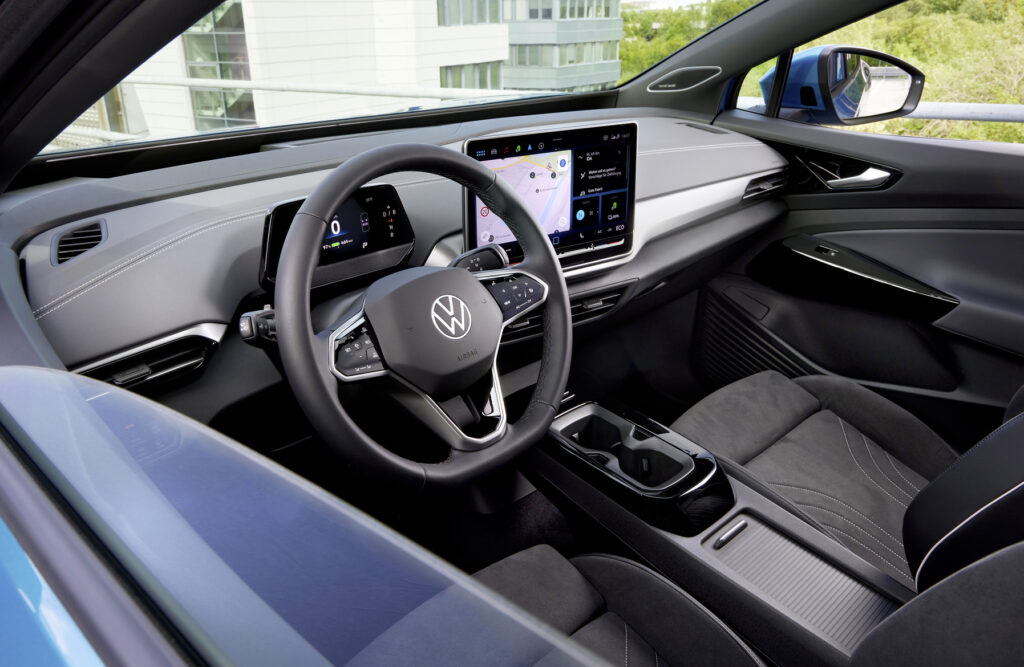
The Volkswagen ID.4 suffers from visibility issues that directly affect safety while driving. Owners report wide A-pillars that obstruct the view of side roads. They also report a reversing camera with poor image quality. This camera is hardly usable at night in particular. These problems are not minor annoyances but design flaws. They significantly complicate reading the traffic situation. Find out why these visibility issues occur and what you can do about them.
Why the A-pillars block your view
The Volkswagen ID.4 has strikingly wide front windscreen A‑pillars. These are the vertical supports between the windscreen and side window. This construction is not a random design choice. The wide pillars are needed to protect the batteries in the floor in a frontal collision. They also have to compensate for the lack of a traditional engine block. This means the structure at the front has to be extra strong.
For drivers this creates a very real problem. When approaching junctions or side roads, pedestrians, cyclists or cars can disappear from view behind the A‑pillar. This requires extra head movements to check the blind spot. This is especially dangerous in busy traffic situations. Some owners experience this as driving with a severely restricted field of vision.
The problem is amplified by modern cars. Electric models in particular have a lower seating position. This is combined with a higher dashboard. This reduces the outward field of view even further. Are you considering switching from a traditional car to the Volkswagen ID.4? Then take this difference into account during a test drive.
How bad is the reversing camera really
The ID.4’s reversing camera scores poorly on usability. Owners report that image quality is mediocre even under optimal conditions. The resolution is low and the sharpness is limited. It becomes problematic when the camera gets dirty. The lens is positioned low down. As a result it quickly gets covered with mud, salt spray or rainwater.
When driving at night, usability drops to around 20%. This is due to the combination of weak lighting and noise in the image. During the day you can still make out the outlines of obstacles. At night, however, the camera produces a dull, unclear picture. For parking in tight spaces or reversing in dark places, this is a serious limitation.
Keeping the camera lens clean helps temporarily but is not a long‑term solution. The camera lacks a heating element or wash function. Other brands do sometimes offer this. This means that in wintry conditions or bad weather you regularly have to stop to wipe the lens clean by hand.
Practical solutions for better visibility
For the A‑pillar problem there are no simple technical modifications possible. This would require major changes to the bodywork. You can, however, adapt your driving style with these tips:
- Move your head deliberately left and right when approaching junctions so you can see around the A‑pillar
- Leave extra space when merging at junctions and on roundabouts
- Drive more slowly in unfamiliar or busy traffic environments
- Use the door mirrors actively as an additional source of information
For the reversing camera there are more concrete steps you can take. Clean the lens regularly with a soft cloth and glass cleaner. Consider a hydrophobic coating that repels water. This makes it harder for dirt to stick. If you have persistent problems, you can ask the dealer about software updates. These may improve image processing.

Are these normal design features or real flaws
The visibility issues raise questions. Are these acceptable design compromises or design flaws? Opinions differ on this. Volkswagen states that the wide A‑pillars are a necessary safety feature for passenger protection in frontal collisions. From a technical perspective this is correct. Crash‑test ratings show that the strong structure saves lives in accidents.
However, this explanation fails to recognise that safety also means preventing dangerous situations. A car that does not help you to see cyclists or pedestrians in time can increase the risk of collisions. This makes it a question of priorities. Volkswagen has given more weight to crash protection than to visibility in everyday driving.
The reversing camera is harder to defend as a design choice. Competing electric models in the same price bracket offer higher‑resolution camera images. They also perform better in low light. The choice of a cheaper camera was a cost‑saving measure, not a technical necessity.
What are the alternatives for better visibility
Do the ID.4’s visibility issues put you off? Then there are electric alternatives with better visibility. The Hyundai Ioniq 5 has slimmer A‑pillars and a wider field of view. The flat dashboard provides more visibility to the outside. The Kia EV6 offers a similar cabin layout with fewer restrictions on outward visibility.
Do you still opt for the ID.4 but want better reversing support? Then consider accessories. Rear and front parking sensors improve detection of obstacles that the camera misses. A dashcam with a rear‑view function often offers better image quality than the factory unit. This does require a separate installation.
Some owners combine the factory camera display with the 360‑degree bird’s‑eye view. This overhead view shows an image from a bird’s‑eye perspective and is available on higher trim levels. This display partly compensates for the shortcomings of the reversing camera. It shows obstacles from multiple angles.
‘ These cannot be fixed with an update. ’
Software updates do not solve hardware limits
Volkswagen has released several software updates for the ID.4. These focus mainly on infotainment issues and problems with driver‑assistance systems. Lane assist helps you stay in your lane. Side assist warns of traffic in the blind spot. The visibility issues with the A‑pillars and camera are related to the hardware. These cannot be resolved via an update.
This means that owners of existing ID.4 models have to learn to live with these limitations. With a possible facelift or next generation, Volkswagen could upgrade the camera quality. The A‑pillars are likely to remain wide due to crash‑safety requirements. Future buyers therefore cannot count on a quick fix.

Find out more about the ID.4 and other models
The ID.4’s visibility issues are an example of design choices that have a direct impact on the everyday driving experience. Are you considering buying an electric car? Do you want to know more about common problems with specific makes and models? Then you will find extensive information on the Carnews website. The website offers technical analyses as well as practical tips for owners. Discover what you need to know before you decide.
Frequently asked questions
ID.4 drivers report that the Front Assist sensor on the front bumper gets dirty quickly, causing warnings about limited or no visibility to appear and resulting in (partial) failure of emergency braking and distance‑monitoring systems. The glitchy infotainment screen also means that the reversing camera and navigation are sometimes unavailable, reducing all‑round visibility and situational awareness. In addition, the sensitive touchpads on the steering wheel cause unintentional operation, making drivers take their eyes off the road for longer to correct functions. Together, these problems increase the risk of distraction, missed warning signals and delayed reactions in traffic.
Besides the visibility issues, the touchpads on the steering wheel are most often mentioned as a design flaw. These sensitive, smooth touch surfaces are easily activated by accident, causing functions to change unintentionally and distracting the driver. In everyday use this leads to irritation, extra vigilance and potentially dangerous situations because attention is diverted from the road.
Through software updates (such as OTA updates and specific packages like “91CA”), Volkswagen has tried to resolve the ID.4’s visibility‑ and software‑related problems. These updates address, among other things, malfunctions in driver‑assistance systems, infotainment and camera/navigation display. For some visibility problems, such as dirty sensors, Volkswagen recommends practical solutions (cleaning, resetting). As far as is known, the design flaw of the touch‑sensitive steering‑wheel controls has not been structurally solved by a hardware change, but mainly mitigated through usage advice.
The ID.4 scores worse on visibility than many competing electric SUVs, mainly due to software malfunctions (such as glitchy camera and assistance systems) and a sensitive Front Assist sensor that can generate warnings about limited visibility. In terms of ergonomics, criticism is mainly directed at the steering‑wheel touchpads, which are easily activated by accident and cause distraction, whereas competitors more often use physical or more clearly differentiated buttons.
Car enthusiasts and potential buyers should pay close attention during a test drive to the operation of the driver‑assistance systems (lane assist, side assist, traffic‑sign recognition) and check whether any error messages or malfunctions appear on the dashboard. Thoroughly test the central infotainment screen: does it respond quickly, does it not freeze and do navigation and cameras work without issues? Also assess visibility all around the car and check whether the Front Assist sensor on the front bumper does not get dirty quickly or display warnings about limited visibility. Finally, pay attention to the steering‑wheel touchpads: are they activated too easily by accident and do they distract you while driving?