
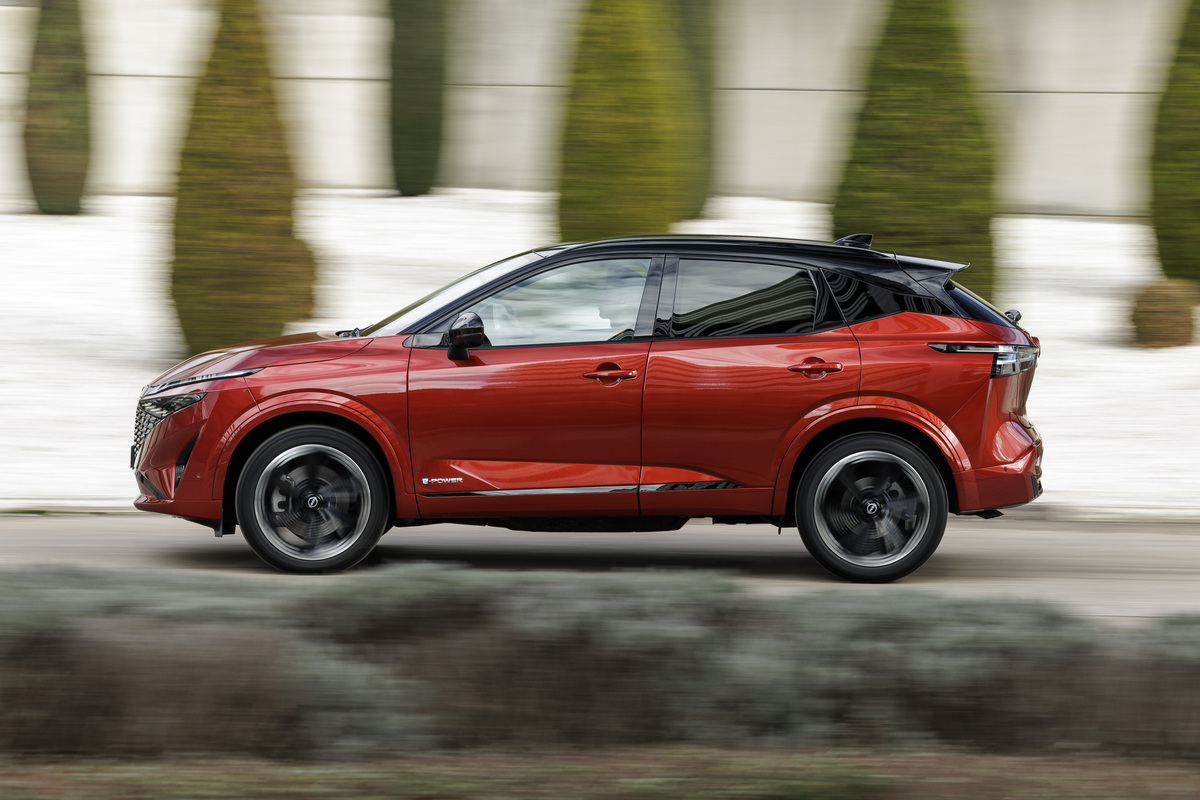
Unequal tyre diameters greatly accelerate wear in the AWD system (all-wheel drive) of the Nissan Qashqai and lead to dashboard warnings, vibrations and gearbox faults. Owners of models with four-wheel drive, in particular, should immediately check the rolling circumference of all four tyres on their Nissan Qashqai. Find out which tyre sizes are suitable and how to prevent AWD problems.
Which tyre size fits your Qashqai AWD model?
The correct tyre size depends on the generation of your Qashqai. Each model has specific approved sizes that are crucial for the operation of the AWD system. Always check the owner’s manual or the tyre sidewall for the exact specification.
For the J10 generation from 2007 to 2014, common sizes are 215/65R16, 215/60R17 and 215/55R18. These are fitted on 16 to 18‑inch wheels with an offset (ET value, the distance between the mounting face and the wheel centre) of 40. The J11 generation, produced between 2014 and 2021, has a similar tyre range with the addition of 225/45R19 for sportier versions. The wheel sizes remain consistent at ET40.
The latest J12 generation from 2021 onwards uses wider tyres. The standard sizes are 215/65R17 and 235/55R18, with options for 235/50R19 and 235/45R20 on larger wheels. These models, including the e‑POWER variant, have 17 to 20‑inch wheels with ET values between 40 and 45. The spare wheel is narrower, usually a 155/90R17 or T145/80R18.
‘ Always replace tyres in sets of two or four, never just a single tyre. ’
Recognising AWD faults caused by incorrect tyres
On AWD models, the rolling circumference of all tyres must be identical. Even small differences in diameter cause problems. This happens due to wear, incorrect sizes, or mixing summer and winter tyres. The AWD system interprets these differences as wheel slip and continually activates corrections.
Recognisable symptoms include a dashboard warning with the message “Incorrect tyre size. See owner’s manual”. Steering wheel vibrations may also occur, especially at higher speeds. In more serious cases, a fault message appears saying “Transmission fault. Stop in a safe place”. This indicates overloading of the AWD clutch.
Many owners report that mixing, for example, 215/60R17 at the front and 215/55R18 at the rear leads to squealing noises from the differential and an illuminated AWD warning light. Traction is noticeably reduced on wet roads. Always measure the diameter of all four tyres. This must be within 1 to 2 per cent of each other. Always replace tyres in sets of two or four, never just a single tyre.
Practical checks for the AWD system
Start with a visual inspection of all tyres. Look for uneven wear, cracks or bulges. Check the tread depth with a tread depth gauge. On AWD models the difference between front and rear tyres must not exceed 2 millimetres.
Check the tyre pressure according to the sticker in the door opening. For most Qashqai models, the recommended pressure is between 2.4 and 2.7 bar. Incorrect pressure affects the rolling circumference and can disrupt the AWD system. Always measure the pressure when the tyres are cold.
Test the AWD system while driving in a safe location. Under acceleration on a loose or slippery surface, the system should engage smoothly without hesitation or unusual noises. Pay attention to:
- Vibrations or juddering when pulling away
- Squeaking or grinding noises from the wheel arches
- Warning lights that stay on
- Reduced traction on wet or unpaved roads
If in doubt, have a specialist read out the fault codes. Many AWD faults are only visible in the diagnostic software.
Winter tyres and AWD compatibility
Winter tyres for the Qashqai AWD require extra attention. Popular choices such as 215/60R17 fit well, but always check the load index and speed index. For AWD models, sizes with 96H or 96V are suitable. Continental WinterContact and Michelin Alpin are widely used options.
Always fit winter tyres on all four wheels. Fitting winter tyres on the front axle only is not permitted on AWD systems. This upsets the balance and can damage the system. Make sure all four winter tyres are identical in size, brand and tread depth.
Pay attention to the ET value when choosing winter wheels. For most Qashqai models ET40 is standard. Different values can lead to clearance issues with the wheel arches or braking system. If in doubt, always use Nissan‑approved combinations of tyres and wheels.
‘ This prevents 90 per cent of all AWD faults. ’
Maintenance to prevent AWD problems
Regular tyre rotation prevents uneven wear. Rotate the tyres every 10,000 kilometres. On AWD models move the fronts to the rear, not cross‑over. This preserves the direction of rotation and extends tyre life.
Have a wheel alignment carried out when fitting new tyres or after replacing suspension components. Incorrect alignment causes uneven wear and puts unnecessary strain on the AWD system. Have this checked at least once a year.
Replace tyres in sets of four when the tread depth drops below 4 millimetres. On AWD models this is more important than on front‑wheel‑drive cars. The difference in diameter must never exceed the permitted margin. Cheap budget tyres often wear unevenly and are therefore less suitable for AWD models.
Have the AWD system inspected during regular services. Check whether the clutch and differential oil levels are correct. Replace them according to the service schedule, usually every 60,000 kilometres. This prevents 90 per cent of all AWD faults.
Upgrades and alternatives for better performance
For heavy loads or frequent off‑road driving, XL tyres (extra load, with reinforced sidewall and higher load capacity) are suitable. These tyres have a reinforced sidewall and offer higher load capacity. Sizes such as 235/55R18 XL are available for the newer Qashqai models.
Larger wheels of 19 or 20 inches improve handling and appearance. Bear in mind that larger wheels with lower‑profile tyres reduce cushioning. The ride becomes firmer and less comfortable. For everyday use, 17 or 18‑inch wheels are often the best choice.
All‑season tyres are a compromise between summer and winter tyres. For mild winters, these may be sufficient. Choose sizes with the 3PMSF symbol (three‑peak mountain snowflake symbol, indicating good performance on snow and ice) for snow and ice grip. Make sure that here too all four tyres are the same size and from the same brand to avoid AWD problems.
Spare wheel and emergency solutions
The spare wheel of the Qashqai is narrower than the standard tyres. Sizes such as T145/80R18 are not suitable for long‑term use. Do not exceed 80 kilometres per hour and replace the spare wheel with a full‑size tyre as soon as possible.
On AWD models, fit the spare wheel preferably on the rear axle. Move a better tyre from the rear to the front. This limits the impact on the AWD system. Drive carefully and avoid sharp bends or hard acceleration.
Consider a tyre repair kit (a compressor with sealant that temporarily repairs small punctures without changing the wheel) as an alternative to a spare wheel. These kits take up less space and are lighter. They are suitable for small punctures in the tread area. In case of more serious damage or sidewall splits, a spare wheel remains essential.
‘ Discover more tips on optimising performance, preventing faults and making the right choices for maintenance. ’
Find out more about the Nissan Qashqai
On the Carnews website you will find extensive information on common problems, maintenance schedules and owner experiences with the Nissan Qashqai. Discover more tips on optimising performance, preventing faults and making the right choices for maintenance. Explore the website and expand your knowledge about your car.
Frequently asked questions
When incorrect tyre sizes are used, there is a difference in rolling circumference between the wheels, causing the AWD clutch to constantly correct. This creates extra load and wear on the AWD system, differential and/or gearbox. The system can then generate fault codes and display messages such as “incorrect tyre size” or “transmission fault”. This can also lead to vibrations, noises and reduced traction.
Check in the owner’s manual, on the door pillar and on the current tyres which sizes are officially approved for your Qashqai generation, and use only those sizes. Make sure all four tyres have the same size and rolling circumference; the difference in diameter between the tyres should be no more than around 1–2%. Preferably always replace four tyres at once, or at least per axle (front and rear the same size and comparable wear). If in doubt, have a tyre specialist measure the diameter and wear of all tyres to prevent damage to the AWD system.
The most sensitive components are the electronically controlled **AWD clutch/Haldex‑type clutch** on the rear axle and the **rear differential**, as they constantly have to correct for different rotational speeds with incorrect tyre sizes. In addition, the **transfer case/drive to the rear axle** and, to a lesser extent, the **gearbox** can also suffer extra wear due to the continuous stresses in the drivetrain.
Warning signs include a message on the dashboard such as “incorrect tyre size. See owner’s manual” or an AWD/gearbox warning light. You may also experience vibrations in the steering or drivetrain and sometimes squeaking or scraping noises when cornering or accelerating. In addition, the car may have noticeably poorer traction, especially on wet roads. In severe cases a message appears such as “transmission fault. Stop in a safe place”.