
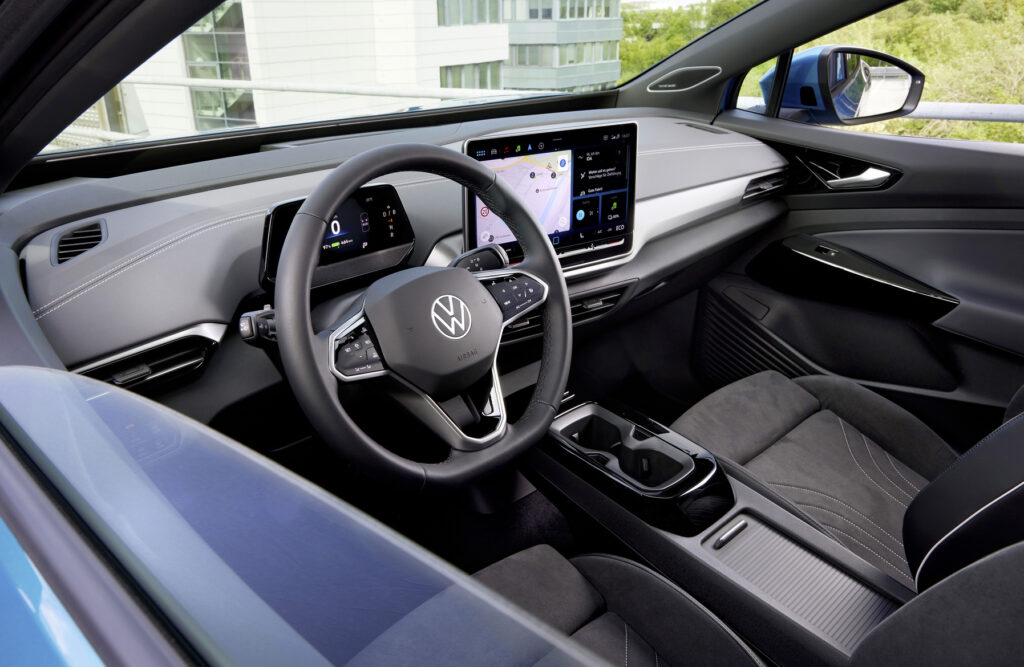
The Volkswagen ID.4 (an electric SUV) is plagued by recurring software issues that manifest themselves as warning lights flashing spontaneously and unexpected horn beeps while driving. These electrical faults are frustrating for owners and turn out to be difficult to resolve at dealer service centres. The cause lies in a complex software architecture with more than 50 control modules (electronic control units that manage various functions in the car) which can influence each other. Discover which glitches occur most frequently and what you can do about them yourself.
Why do warning lights flash randomly in the ID.4
ID.4 owners regularly report that warning lights start flashing for no apparent reason. The dashboard screen suddenly lights up with various warnings even though there is no actual fault. This phenomenon mainly occurs in models from 2021 up to and including 2023.
The cause lies in software errors within the network of control modules. The ID.4 has an extensive system in which fifty different modules are constantly communicating with each other. A small error in one module can trigger a domino effect, causing other systems to generate false alarm messages. This explains why dealers often cannot diagnose a concrete fault with their standard diagnostic equipment.
Volkswagen has issued several Technical Service Bulletins (internal service notices for dealers with solutions for known issues) for this problem. In the United States, more than 44,000 ID.4 models have already been affected by recalls (product recalls to remedy faults) relating to software problems with battery monitoring and display issues. A dealer visit for a firmware update (updating the car’s built-in software) resolves the problem in many cases, but not always definitively.
‘ This unpredictable glitch creates dangerous situations in traffic. ’
What causes unexpected horn signals while driving
A particularly irritating fault is the horn sounding spontaneously while driving on motorways. Several owners describe situations in which the horn starts blaring for no reason, often several times in a row. This unpredictable glitch creates dangerous situations in traffic.
This problem is related to errors in the software that controls the door locks and control buttons. The control module that manages the steering wheel controls can, due to a software error, send incorrect signals to the horn system. The sensors in the door handles can also issue unexpected commands due to software glitches.
Owners report that a full reset of the system provides temporary relief. Press and hold the infotainment power button or the OK button on the steering wheel for ten to fifteen seconds to restart the system. If this does not help, a dealer visit is necessary for a thorough software flash (a complete reinstallation of the car software at the dealer).
How dealers diagnose ID.4 software faults
Many owners are frustrated because dealer service centres cannot identify or resolve the reported problems. The diagnostic tools (reading and test equipment for fault codes and system status) used by dealers only detect hardware faults and permanent software errors. Temporary glitches that only occur sporadically often remain invisible in the diagnostic data.
When dealing with electrical faults, dealers follow a standard procedure. They first read the fault codes from all control modules and check whether there are any open recalls for the specific chassis number. They then carry out a full system test in which various functions are activated manually. If no concrete faults are found, they update the firmware to the latest version.
The problem is that the software architecture of the ID.4 is not yet fully mature. Over-the-air updates (software updates sent to the car via the internet without a dealer visit) intended to solve problems regularly cause new faults. Owners report that after an OTA update (over-the-air, wireless update) their car sometimes will not start for days, meaning the vehicle has to be towed to the dealer for a manual recovery flash.
Common diagnostic problems at dealers
- Fault codes disappear from memory before the car arrives at the dealer
- Intermittent faults do not occur during the test drive
- Diagnostic equipment only recognises hardware defects, not software glitches
- Updates solve one problem but cause new faults
Can software errors in the ID.4 be fixed with updates
Volkswagen offers both over-the-air updates and dealer flashes to remedy software problems. In theory, these updates should fix most glitches, but reality is more stubborn. Owners report mixed results, with some updates making problems worse instead of solving them.
The latest update 91VH, intended to add charging improvements and NACS adapter support (support for Tesla’s North American Charging Standard, for which an adapter is required), has led to completely non-starting cars for several owners. Forums are full of stories about ID.4 models that freeze during the update and can then only be made operational again by Volkswagen technicians on site. Waiting times of days to weeks are not unusual.
Models from 2024 and 2025 generally show fewer problems than earlier model years. This indicates that Volkswagen is gradually improving the software architecture. Even so, the OTA infrastructure remains more vulnerable than that of competitors. Many owners therefore choose to disable automatic updates and have updates installed only at the dealer under controlled conditions.
Practical tips to minimise ID.4 software glitches
You can take several steps yourself to reduce the chance of software problems and to resolve minor faults before you need to go to the dealer. These methods work mainly for lighter glitches such as a frozen infotainment screen or connectivity problems.
Always start with a soft reset by holding down the infotainment power button or the OK button on the steering wheel for ten to fifteen seconds. This restarts the infotainment system without losing your data. If that does not help, try a full sleep cycle by parking the car, switching everything off and leaving it completely undisturbed for at least thirty minutes without opening the Volkswagen ID.4 app (the official smartphone app for controlling and monitoring the car). Then restart the vehicle.
For Bluetooth problems (issues with the wireless connection between phone and car), it is effective to remove the phone from the car and delete the car from the phone, then pair again. If necessary, test with another device to rule out that the problem lies with your phone. For over-the-air updates it is wise to ensure at least fifty per cent battery charge and a strong Wi‑Fi or mobile connection before starting the update.
Steps for an effective DIY reset
- Hold down the infotainment power button for ten to fifteen seconds for a soft reset
- Park the car and leave it completely locked for at least thirty minutes
- Remove Bluetooth pairings both in the car and on your phone and pair again
- Ensure sufficient battery charge and a stable connection for OTA updates
- Avoid repeatedly starting and stopping the car during an ongoing update

Owners’ experiences with electrical faults
On forums such as Reddit communities for the Volkswagen ID and ID.4, owners openly share their experiences with software problems. A recurring theme is the frustration about the gap between the expected quality of a fifty‑thousand‑euro electric car and the reality of daily software glitches.
The owner of a 2025 Pro S describes how his car spent a week at the dealer for the 91VH update. During installation the system completely failed, so Volkswagen corporate had to intervene to get the car working again. Although charging then improved, the app kept unreliably going offline. Another user reports that the app is unavailable on a daily basis and that doors spontaneously deadlocked while driving on the motorway.
Not all experiences are negative. Owners of 2024 models with recent dealer updates often report that their problems have disappeared completely after a thorough firmware flash. German forums confirm this pattern and describe the software of early models as not yet fully developed, while newer cars from 2025 benefit from a more mature OTA infrastructure (a more stable system for wireless software updates).
Why do these faults occur so often in the ID.4
The electrical architecture of the ID.4 is considerably more complex than that of traditional combustion‑engine cars. More than fifty control modules must constantly communicate with each other via a single central network. A fault in one module can therefore trigger a chain reaction of error messages in other systems.
This complexity makes the system vulnerable to software errors that are difficult to predict. Volkswagen has opted for a modular design in which different suppliers provide parts of the software. Combining these subsystems into one functioning whole is proving more difficult than expected, especially with over‑the‑air updates that have to synchronise the entire system.
In addition, the ID.4 is under pressure to add new functions regularly and to optimise charging performance. Every update carries the risk that new code will cause conflicts with existing modules. This explains why recalls mainly focus on battery contactors, display blanks and charging limits – all areas where software and hardware work together intensively.
On the Carnews website you will find much more information about electric cars, software problems at different brands and practical tips for maintaining modern vehicles. Explore the in‑depth articles and expand your knowledge of the latest developments in the automotive world.
Frequently asked questions
The question is not clear, because “[object Object]” usually indicates an error in displaying the real question or data. Check whether the original question or text is being passed on correctly and try again.
The question “[object Object]” contains no substantive information on which a meaningful answer can be based.
The question is unclearly worded because “[object Object]” does not represent a substantive question, but seems to indicate an error in how data is displayed (for example from a web application). It is likely that an object from code or a system has accidentally been shown as text instead of the actual question. To be able to give a substantive answer, the original, readable question is required.
The question “[object Object]” contains no substantive information from which I can infer or answer a meaningful question.