
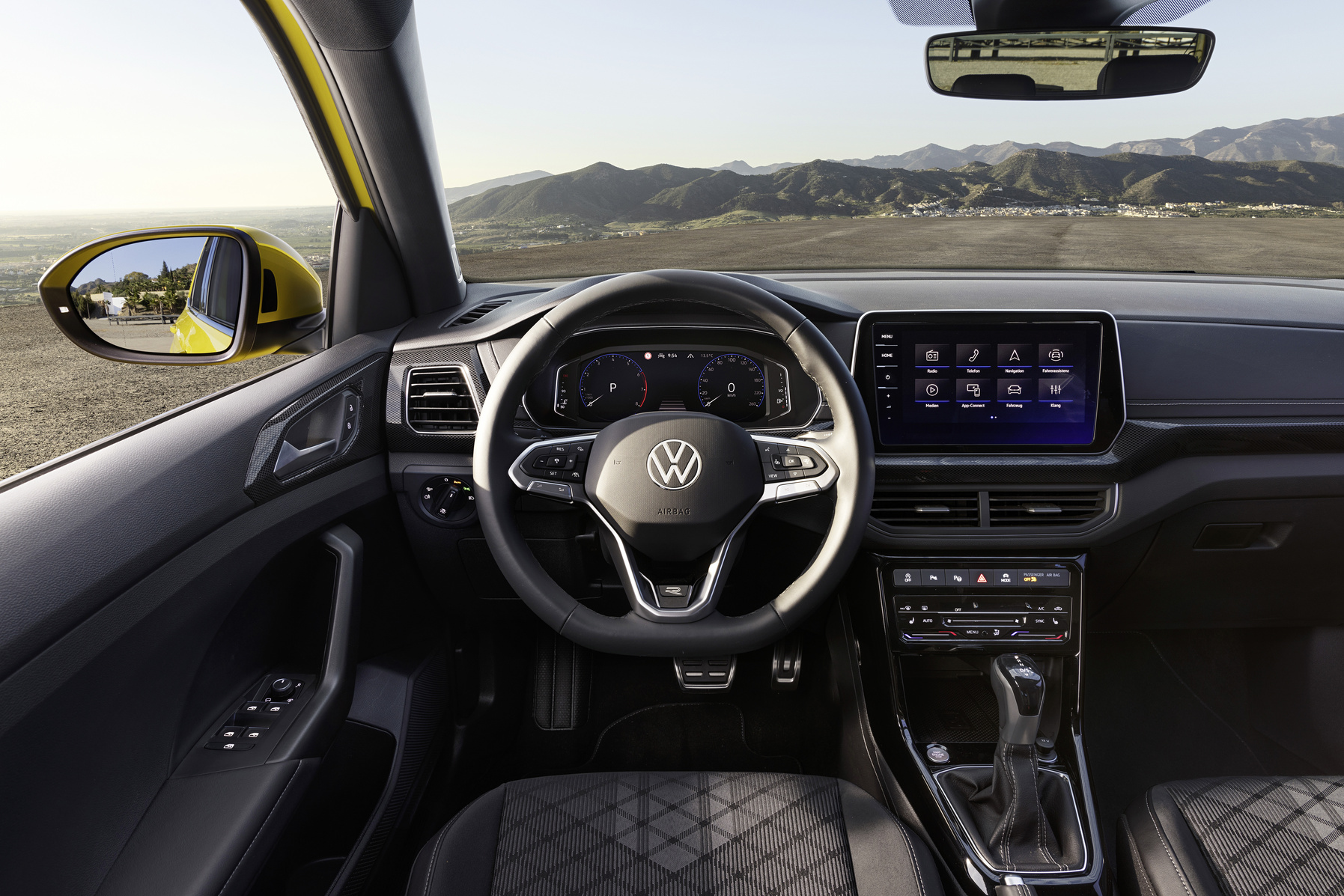
The Volkswagen T-Cross 2026 starts at €31,007 for the entry-level version and goes up to €43,990 for the fully equipped R-Line Edition. This compact SUV offers a clear overview of trims with concrete price differences per engine version and equipment level. Do you want to know whether this car fits your budget and needs?
What does the Volkswagen T-Cross 2026 cost per trim level
The T-Cross 2026 is available in three main trims: Edition, Life Edition and R-Line. The entry price of €28,990 for the Edition already gets you electrically folding mirrors and height-adjustable seats. For the Life Edition with 1.0 TSI 95 hp manual you pay €31,007 including all on-the-road costs. If you choose the 115 hp version with manual gearbox, the price rises to €34,990.
The Life Edition with DSG-7 automatic costs €42,990, which means a price difference of €8,000 compared with the manual version. For the R-Line you pay from €34,407 with manual gearbox. The R-Line Edition with 116 hp and DSG-7 automatic starts at €35,234. The top model with DSG automatic and 133 g/km CO2 emissions comes to €36,981.
Stock models with low mileage are often more affordable. New 2026 models with fewer than 50 kilometres on the clock are available from €32,136. These cars are often already equipped with a towbar, reversing camera and navigation. Some dealers offer additional trade-in bonuses of up to €2,000.
‘ The price difference of about €3,000 between Life Edition and R-Line is mainly in the styling and appearance of the Volkswagen T-Cross. ’
Main differences between Life Edition and R-Line
The Life Edition focuses on comfort and everyday usability. This trim has adaptive cruise control, parking sensors and up to 455 litres of boot space as standard. The interior is functionally laid out with basic digital displays. For city driving, this version is perfectly adequate.
The R-Line adds a sportier look with modified bumpers and unique alloy wheels. Inside you notice the difference through sportier seats and darker accents. The standard equipment corresponds to that of the Life Edition, but the visual character is clearly different. Owners mainly choose the R-Line for its looks, not for extra technical features.
For daily use, the practical differences are limited. Both trims offer the same engine options and comparable standard equipment. The price difference of around €3,000 between Life Edition and R-Line lies mainly in the styling and appearance of the Volkswagen T-Cross. If you are unsure which trim suits you, test both during a test drive.

Which engine option and transmission suit you
The 1.0 TSI with 95 hp is the most economical choice with fuel consumption of around 18.5 kilometres per litre. This engine is suitable for city driving and short trips. For motorway driving and overtaking this version is adequate, but do not expect sporty performance. The manual gearbox operates smoothly and responds directly.
If you choose 115 or 116 hp, you get more pulling power at higher speeds. The difference in everyday use is noticeable when overtaking and when the car is fully loaded. The DSG-7 automatic is comfortable in stop-start traffic and shifts smoothly. The €8,000 price difference is considerable, but it does offer more driving comfort if you do a lot of city driving.
Owners report that the 1.0 TSI engine runs smoothly and shows stable behaviour on winding roads. Wind noise above 120 kilometres per hour is reported regularly. This is not a technical issue, but it is noticeable on long motorway journeys. Test this during the test drive to assess whether this is acceptable for you.
Options and packages that add value
The Digital Cockpit Pro with a 26-centimetre screen costs €322 and offers traffic sign recognition plus voice control. This option makes the dashboard more modern and increases ease of use. Wireless App-Connect for €777 integrates your smartphone without cables. For everyday use this is handy, but not essential.
The parking assistant for €364 helps with parking in tight spaces. In the city this is a valuable aid. The comfort package adds heated seats, lumbar support and keyless entry. This package costs around €1,000 and significantly increases comfort. Negotiate with the dealer about bundles to save on costs.
Standard equipment on higher trims already includes many safety features. Adaptive cruise control and a reversing camera are often included. A towbar with 1,000 kilograms braked trailer capacity is available. Check which options are already fitted on stock models to avoid additional costs.
‘ For those who want to keep the car for a long time, buying is often cheaper than long-term leasing. ’
Private lease or buy
Private lease starts at €439 per month for a 60‑month contract and 5,000 kilometres per year. For 10,000 kilometres per year you pay around €555 per month. These amounts include servicing, MOT and fully comprehensive insurance. Operational lease is slightly higher at €487 per month.
If you buy, you pay road tax of between €172 and €188 per quarter. You can compare total ownership costs over five years with 20,000 kilometres per year via dealer tools. Take into account costs for servicing, insurance and depreciation. For those who plan to keep the car for a long time, buying is often cheaper than long-term leasing.
Buying new gives you four years’ warranty and meets Euro 6d emissions standards. Used cars from 2020 onwards are available from €16,000, but tend to have higher mileage. Weigh up the condition of the car and remaining warranty when buying second-hand. A new 2026 model offers peace of mind and the latest technology.

Practical tips for your purchase decision
During the test drive, check whether the DSG automatic suits your driving style. Test it specifically in traffic jams and on slip roads. Pay attention to the 455‑litre boot and see whether this is sufficient for your use. The folding rear seat significantly increases the load space.
Ask about current dealer promotions and trade‑in terms. Some dealers offer discounts on stock models or free servicing. Compare prices at several dealers before you decide. Check which options are already included to avoid paying twice.
Decide on your priorities in advance. If you mainly want comfort, the Life Edition with comfort package is sufficient. If you go for looks, the R-Line is a better fit. Make a realistic estimate of your annual mileage so you can properly compare lease and purchase costs. Always factor in all ongoing costs for a fair comparison.
How the T-Cross scores in daily use
Owners appreciate the generous boot space and manageable size in the city. The T-Cross is manoeuvrable and easy to park. The raised seating position provides good visibility in traffic. For families, the car offers enough space on the rear seat.
The 1.0 TSI engine performs well on short and medium journeys. With a full load you notice that the engine has to work harder. This is normal for a three-cylinder with this output. The road holding is stable, even on winding roads. Steering response is direct without being overly sporty.
Fuel consumption of 18.5 kilometres per litre is achievable with calm driving. In practice, the average is often slightly higher, depending on driving style and conditions. Servicing is easily arranged via the Volkswagen network. Warranty conditions are clear and service costs are comparable with other brands in this segment.
‘ For anyone who values Volkswagen quality and a straightforward SUV, the T-Cross 2026 is a sensible choice. ’
Is the T-Cross 2026 worth it
The T-Cross 2026 combines practical dimensions with modern technology and sufficient space. For anyone looking for a compact SUV with decent equipment, this car offers good value for money. Prices from €31,007 are realistic for the standard equipment and safety you get.
The price difference between trims calls for a deliberate choice. The Life Edition is sufficient for most users. The R-Line mainly adds visual appeal. The engine versions are reliable and deliver adequate performance for everyday use. The DSG automatic is worth the extra cost if you drive a lot in town traffic.
Always compare with alternatives in the same segment. Test the car thoroughly before you decide. Take into account total costs over the period you plan to keep the car. For anyone who values Volkswagen quality and a straightforward SUV, the T-Cross 2026 is a sensible choice.
On the Carnews website you can find more information about maintenance costs, comparisons with other compact SUVs and practical tips on car ownership. Discover what the best choice is for your situation and read more about experiences with different models.
Frequently asked questions
The VW T-Cross 2026 starts at around €31,000 for the Life Edition 1.0 TSI 95 hp with manual gearbox and in practice goes up to around €44,000 for well-equipped R‑Line Edition models with 116 hp and DSG automatic. Intermediate Life and R‑Line versions with 115/116 hp and manual or DSG fall broadly in the €34,000 to €41,000 band, depending on engine and options. This clearly positions the T‑Cross at the upper end of the compact SUV segment, more expensive than many Asian and French rivals but comparable with other German and more “premium”-oriented models. The higher price is mainly justified by finish, equipment, and safety and connectivity options.
The Life Edition has as standard, among other things, air conditioning, LED headlights, electrically folding mirrors and height-adjustable seats; popular options include Digital Cockpit Pro (approx. €322), wireless App-Connect (approx. €777) and a parking assistant (approx. €364). The R-Line adds sportier bumpers and wheels, extra interior accents and often more driver-assistance systems, while the R-Line Edition is usually even more complete with, among other things, more extensive assistance systems and infotainment. On the higher trims, features such as adaptive cruise control, all-round parking sensors and often extra comfort features are already standard, so individual option prices become less relevant. The surcharge for popular options is roughly between €300 and €800 each, while complete packages with, for example, seat heating and keyless entry usually cost around or under €1,000 extra.
For the VW T-Cross 2026 there are broadly two engine options: the 1.0 TSI with 95 hp (manual only, mainly on the Life Edition) and the 1.0 TSI with 115/116 hp (manual or DSG‑7 automatic on Life, R-Line and R-Line Edition). The entry-level Life Edition with 95 hp starts at around €31,000, while better equipped and more powerful R-Line (R-Line Edition) variants with 115/116 hp and DSG rise to around €41,000–€44,000. The DSG and more powerful engine variants increase the purchase price due to higher purchase tax (BPM) and more equipment, but offer more comfort and better performance. In terms of running costs, the higher weight, power and sometimes higher CO₂ emissions of the DSG versions lead to slightly higher fuel consumption and road tax than the 95 hp manual base version.
For the VW T-Cross 2026, higher-spec versions (such as R-Line or R-Line Edition) and sought-after safety and comfort options generally have a positive effect on residual value, because they make the car more attractive on the used market. Popular options such as Digital Cockpit, parking systems and wireless App-Connect are often in demand and tend to hold their value relatively well. Over‑specifying or fitting very expensive equipment above the segment average (for example all packages and an expensive DSG combined with the weakest engine) does not always result in a proportionally higher residual value. For a long-term purchase decision, a mid to higher trim level with the most in-demand, practical options is usually the best balance between purchase price and future residual value.
Volkswagen is not offering specifically named “launch editions” for the introduction of the T-Cross 2026, but there are Edition, Life Edition, R‑Line and R‑Line Edition trims that are positioned as attractively priced packages. The starting price is around €31,007 for the Life Edition 1.0 TSI 95 hp with manual gearbox, with higher-spec R‑Line versions up to around €43,990. Private lease offers start at around €439–€555 per month (60 months, 5,000–10,000 km/year), including servicing and fully comprehensive insurance. Any temporary launch offers or extra introductory discounts depend on the dealer and are not fixed across the board.