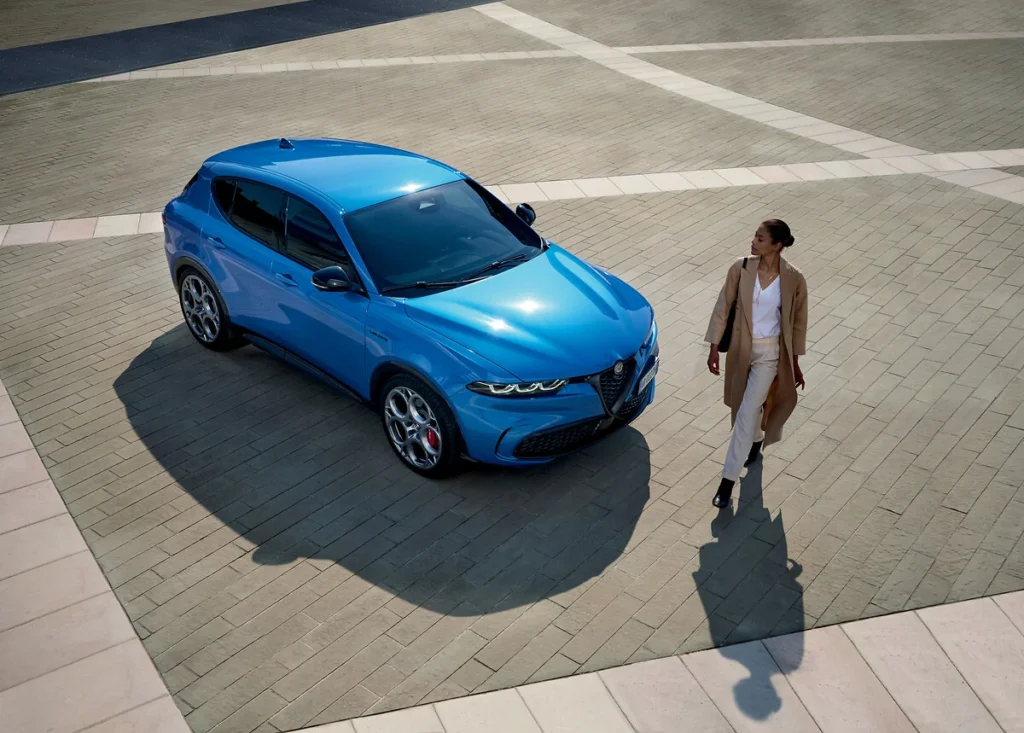
On the motorway, the Alfa Romeo Tonale mild-hybrid is only slightly more efficient than traditional petrol SUVs, because the small 48V battery offers little assistance there. Expect around 6.5–7.5 l/100 km at 100 km/h and 7.5–9.0 l/100 km at 130 km/h. The greatest hybrid benefit comes mainly in city traffic and when there is lots of braking and coasting.
How does the 48-volt electric motor in the ‘mild-hybrid’ drivetrain affect the actual fuel consumption of the Alfa Romeo Tonale during dynamic driving on winding roads?
The 48V electric motor recovers energy when braking for corners and supports the petrol engine when accelerating out of them, which reduces consumption slightly. However, during dynamic driving the small battery quickly runs low and strong acceleration uses a lot of petrol, so the hybrid benefit remains limited. Real-world consumption is therefore generally above the WLTP figure and more in the region of 6.5–8.0 l/100 km, or higher with a very sporty driving style.
What is the actual ‘fuel consumption’ of the Tonale ‘VGT’ engine compared with the factory specifications under different driving conditions?
The Tonale with the VGT mild-hybrid engine has an official WLTP consumption of around 5.6–6.5 l/100 km, but in practice 6.5–8.0 l/100 km is more realistic. On quiet country roads, 5.0–6.0 l/100 km is achievable, compared with 6.5–7.5 in mixed driving. In heavy city traffic or with a cold engine, this rises to 7.0–9.0 l/100 km. On the motorway it is around 6.5–7.5 l/100 km at 100 km/h and 7.5–9.0 at 130 km/h.
To what extent does regenerative braking contribute to the efficiency of the ‘mild-hybrid’ configuration during sporty driving?
Regenerative braking improves efficiency because energy that would otherwise be lost as heat is stored for electric assistance and short electric driving. During sporty driving there are more and heavier braking moments, but the small 48V battery can only absorb a limited amount of energy and fills up quickly. Moreover, brisk acceleration uses a lot of fuel and the stored energy is used up quickly. Its contribution is therefore noticeable, but it only compensates for a small part of the higher consumption.
How does the efficiency of this Italian ‘SUV’ on the motorway compare with traditional petrol versions without electric assistance?
On the motorway, the Alfa Romeo Tonale mild-hybrid is only slightly more efficient than traditional petrol SUVs, because the small 48V battery offers little assistance there. Expect around 6.5–7.5 l/100 km at 100 km/h and 7.5–9.0 l/100 km at 130 km/h. The greatest hybrid benefit comes mainly in city traffic and when there is lots of braking and coasting.
Frequently asked questions
How does the 48-volt electric motor in the ‘mild-hybrid’ drivetrain affect the actual fuel consumption of the Alfa Romeo Tonale during dynamic driving on winding roads?
The 48V electric motor recovers energy when braking for corners and supports the petrol engine when accelerating out of them, which reduces consumption slightly. However, during dynamic driving the small battery quickly runs low and strong acceleration uses a lot of petrol, so the hybrid benefit remains limited. Real-world consumption is therefore generally above the WLTP figure and more in the region of 6.5–8.0 l/100 km, or higher with a very sporty driving style.
What is the actual ‘fuel consumption’ of the Tonale ‘VGT’ engine compared with the factory specifications under different driving conditions?
The Tonale with the VGT mild-hybrid engine has an official WLTP consumption of around 5.6–6.5 l/100 km, but in practice 6.5–8.0 l/100 km is more realistic. On quiet country roads, 5.0–6.0 l/100 km is achievable, compared with 6.5–7.5 in mixed driving. In heavy city traffic or with a cold engine, this rises to 7.0–9.0 l/100 km. On the motorway it is around 6.5–7.5 l/100 km at 100 km/h and 7.5–9.0 at 130 km/h.
To what extent does regenerative braking contribute to the efficiency of the ‘mild-hybrid’ configuration during sporty driving?
Regenerative braking improves efficiency because energy that would otherwise be lost as heat is stored for electric assistance and short electric driving. During sporty driving there are more and heavier braking moments, but the small 48V battery can only absorb a limited amount of energy and fills up quickly. Moreover, brisk acceleration uses a lot of fuel and the stored energy is used up quickly. Its contribution is therefore noticeable, but it only compensates for a small part of the higher consumption.
How does the efficiency of this Italian ‘SUV’ on the motorway compare with traditional petrol versions without electric assistance?
On the motorway, the Alfa Romeo Tonale mild-hybrid is only slightly more efficient than traditional petrol SUVs, because the small 48V battery offers little assistance there. Expect around 6.5–7.5 l/100 km at 100 km/h and 7.5–9.0 l/100 km at 130 km/h. The greatest hybrid benefit comes mainly in city traffic and when there is lots of braking and coasting.
The fuel consumption of the mild-hybrid Tonale in everyday use is often higher than the official figure. Around 6.5 to 8.0 litres per 100 kilometres is a better starting point than the lowest WLTP value. The car has to get its weight moving, while the electric motor in the transmission mainly helps at low speeds. It is not designed to cover long distances electrically. So a high reading on the onboard computer does not immediately point to a fault. When is extra consumption normal, and when is investigation worthwhile?
What is a realistic fuel consumption figure for the Alfa Romeo Tonale?
According to Alfa Romeo’s WLTP figures, the mild-hybrid versions consume roughly 5.6 to 6.5 litres per 100 kilometres, depending on variant and equipment. For mixed everyday use, around 7 litres per 100 kilometres is a more realistic benchmark. If you do lots of short trips or regularly drive at 130 km/h, consumption can rise towards 8 litres or more.
The Tonale has been offered with several power outputs of the 1.5-litre turbo petrol engine with 48V hybrid technology, including versions of around 130, 160 and 175 hp. So do not simply compare the onboard computer with the lowest figure in a brochure. First look at the WLTP value for your specific version, including wheel size and equipment. If you are researching it because of unexpected consumption or different driving behaviour, also see the information on Alfa Romeo Tonale issues.
The following ranges help you assess your own journeys. They are indicative: traffic, temperature, load and driving style all change the result.
- Relaxed country-road driving: about 5.0 to 6.0 l/100 km.
- Mixed traffic: about 6.5 to 7.5 l/100 km.
- Busy city driving with a cold engine: about 7.0 to 9.0 l/100 km.
- Motorway at around 130 km/h: about 7.5 to 9.0 l/100 km.
A favourable journey of 5 litres per 100 kilometres is therefore possible, but it is not a useful norm for every fill-up. The WLTP test is mainly intended to compare cars under the same conditions. A cold morning commute or a long motorway journey differs greatly from those test conditions.
‘ The electric motor helps keep that consumption down, but it cannot offset it in all conditions. ’
Why is the Tonale’s fuel consumption higher?
The weight and shape of an SUV demand energy when pulling away and when maintaining speed. The electric motor helps to limit that consumption, but cannot offset it in all conditions. In particular, the balance between low-speed driving and motorway miles determines how much benefit you notice from the hybrid system.
The 48V electric motor helps mainly at low speed
The electric motor in the mild-hybrid Tonale is integrated into the transmission. The system recovers energy while coasting and braking, supports pull-away, and can briefly allow the car to drive electrically in suitable conditions. The petrol engine can also switch off temporarily while rolling. That is something different from long-distance electric driving in a plug-in hybrid.
The electric motor is not a separate electric drive that you can use for a long journey or power via a charging cable. The compact 48V battery has to recover its energy on the move. On a journey with few braking moments, such as a steady motorway run, the opportunities for energy recovery are limited. The petrol engine then does most of the work.
Speed and cold starts cost the most
Above 100 km/h you will notice the effect of air resistance increasing. At 130 km/h, the petrol engine therefore has to deliver more power than at 100 km/h, while the brief electric assistance makes little difference. Headwinds, a roof box and wide tyres make that effect even greater.
Short trips have a different drawback. The petrol engine and transmission start out cold, while the journey is sometimes over before they have properly warmed up. Heating, air conditioning and other electrical consumers also require energy. So do not assess fuel consumption over five kilometres as if it were a reliable prediction for longer distances.
This is how to save fuel with the Tonale hybrid
You will gain the most by allowing the 48V system the chance to recover energy and by avoiding unnecessary load. Try these steps individually to see which measure has an effect on your route.
- Lift off the accelerator early. Look further ahead and coast when you approach a junction or traffic light. This gives the system more opportunity to recover energy.
- Accelerate smoothly. The electric motor can provide brief support, but strong acceleration mainly demands extra fuel from the petrol engine.
- Compare two speeds on the same route. The difference between 100 and 130 km/h can be clearly visible in the average consumption of an SUV.
- Check tyre pressure when the tyres are cold. Use the prescribed value that matches the load. Pressure that is too low increases rolling resistance.
- Remove roof bars when you are not using them. They increase drag, especially at higher speeds.
- Combine short trips where possible. One longer journey means fewer cold starts than several separate trips.
Also pay attention to the driving mode you have selected. A sporty setting alters throttle response and may lead you to accelerate more aggressively. Then check over several fill-ups whether changing your driving style really makes a difference; one trip tells you too little.
When does high consumption merit investigation?
A Tonale that uses 8 litres per 100 kilometres in winter on short city trips does not necessarily have a fault. If consumption remains noticeably high on longer, similar journeys, first check tyre size, pressure, load and speed. Also look at whether your onboard computer shows a journey average or an average over thousands of kilometres.
Then measure at the pump. Divide the number of litres filled by the kilometres driven and multiply the result by 100. For example: 42 litres after 600 kilometres is 7.0 litres per 100 kilometres. Repeat this over several full tanks; differences in fuel level and conditions then matter less.
Also pay attention to the drivetrain’s behaviour. Tests have noted that the petrol engine switching back on can sometimes be noticeable, for example while coasting slowly. A jolt, a delayed throttle response or a stop-start function that is not active does not in itself prove a fault. In combination with warnings from the hybrid system and persistently high consumption, however, a check by a specialist is sensible. If you are considering a used Tonale, ask whether any available software updates have been carried out.
So for the mild-hybrid Tonale, it is better to work from your own pump readings than from the WLTP figure alone. On Carnews you can find more about the Tonale, car problems and maintenance. That information helps you assess your car more accurately.
Frequently asked questions
How does the 48-volt electric motor in the ‘mild-hybrid’ drivetrain affect the actual fuel consumption of the Alfa Romeo Tonale during dynamic driving on winding roads?
The 48V electric motor recovers energy when braking for corners and supports the petrol engine when accelerating out of them, which reduces consumption slightly. However, during dynamic driving the small battery quickly runs low and strong acceleration uses a lot of petrol, so the hybrid benefit remains limited. Real-world consumption is therefore generally above the WLTP figure and more in the region of 6.5–8.0 l/100 km, or higher with a very sporty driving style.
What is the actual ‘fuel consumption’ of the Tonale ‘VGT’ engine compared with the factory specifications under different driving conditions?
The Tonale with the VGT mild-hybrid engine has an official WLTP consumption of around 5.6–6.5 l/100 km, but in practice 6.5–8.0 l/100 km is more realistic. On quiet country roads, 5.0–6.0 l/100 km is achievable, compared with 6.5–7.5 in mixed driving. In heavy city traffic or with a cold engine, this rises to 7.0–9.0 l/100 km. On the motorway it is around 6.5–7.5 l/100 km at 100 km/h and 7.5–9.0 at 130 km/h.
To what extent does regenerative braking contribute to the efficiency of the ‘mild-hybrid’ configuration during sporty driving?
Regenerative braking improves efficiency because energy that would otherwise be lost as heat is stored for electric assistance and short electric driving. During sporty driving there are more and heavier braking moments, but the small 48V battery can only absorb a limited amount of energy and fills up quickly. Moreover, brisk acceleration uses a lot of fuel and the stored energy is used up quickly. Its contribution is therefore noticeable, but it only compensates for a small part of the higher consumption.
How does the efficiency of this Italian ‘SUV’ on the motorway compare with traditional petrol versions without electric assistance?
On the motorway, the Alfa Romeo Tonale mild-hybrid is only slightly more efficient than traditional petrol SUVs, because the small 48V battery offers little assistance there. Expect around 6.5–7.5 l/100 km at 100 km/h and 7.5–9.0 l/100 km at 130 km/h. The greatest hybrid benefit comes mainly in city traffic and when there is lots of braking and coasting.