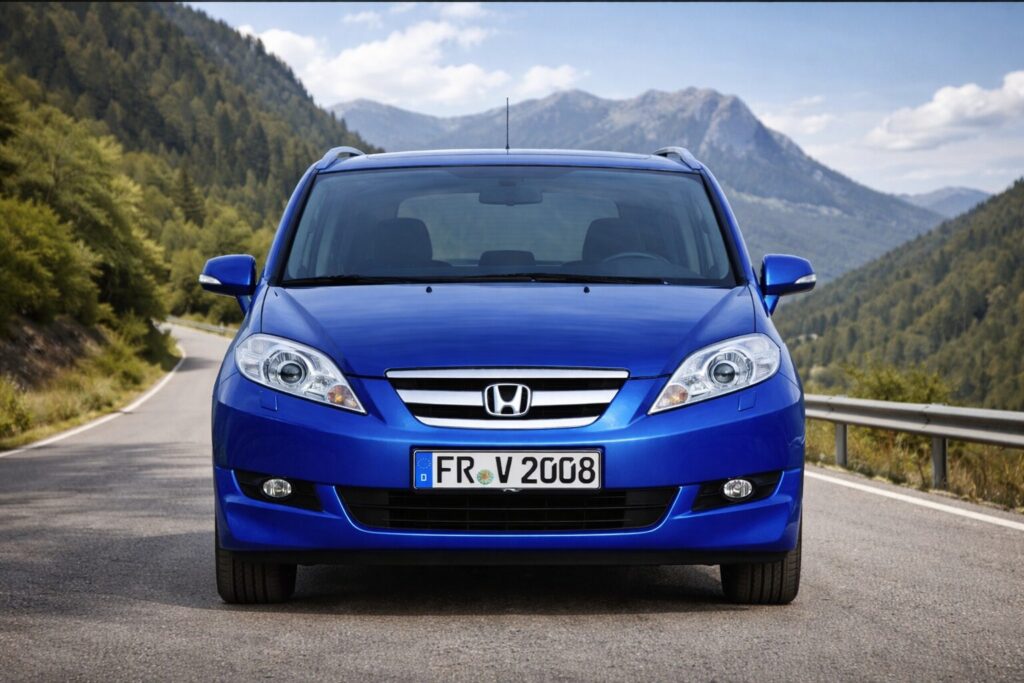
On the Honda FR-V 2.2 i-CTDi, diesel particulate filter problems are mainly caused by short journeys and low load, which keep the exhaust temperature too low and interrupt regenerations. A contaminated EGR valve or worn/contaminated injectors causes incomplete combustion and extra soot formation. Faulty differential pressure or temperature sensors, blocked pressure hoses and leaks at the exhaust manifold can disrupt regeneration control. At higher mileages, non-combustible ash also causes persistent back pressure, even when regeneration still works.
What effect does the lack of a standard regeneration cycle on shorter journeys have on the filter’s saturation level?
On short journeys, the exhaust temperature needed for regeneration is often not reached. Without a full regeneration cycle, the accumulated soot is not burned off sufficiently, causing the filter’s saturation level to rise further and further. This increases the risk of blockage, back pressure, loss of power and, eventually, a forced regeneration or cleaning.
Is thermal cleaning of the diesel particulate filter a durable option, or is full replacement necessary for this specific build quality?
Thermal cleaning is a durable option if the diesel particulate filter is physically intact and the cause of the contamination is dealt with first. Full replacement is only necessary if the filter has melted, cracked or suffered structural damage, or if back pressure remains too high after professional cleaning. The build quality alone does not automatically make replacement necessary.
What performance losses appear on the dynamometer when the DPF has become completely blocked?
A completely blocked DPF causes very high exhaust back pressure, which means the measured power and torque on the dynamometer drop sharply. The engine responds slowly, builds less turbo boost and may enter limp mode, so peak power is not reached. Exact loss figures are not stated and depend on the degree of blockage and the engine management system.
What are the specific technical causes of diesel particulate filter problems in the Honda ‘i-CTDi’ engine in the FR-V?
On the Honda FR-V 2.2 i-CTDi, diesel particulate filter problems are mainly caused by short journeys and low load, which keep the exhaust temperature too low and interrupt regenerations. A contaminated EGR valve or worn/contaminated injectors causes incomplete combustion and extra soot formation. Faulty differential pressure or temperature sensors, blocked pressure hoses and leaks at the exhaust manifold can disrupt regeneration control. At higher mileages, non-combustible ash also causes persistent back pressure, even when regeneration still works.
What effect does the lack of a standard regeneration cycle on shorter journeys have on the filter’s saturation level?
On short journeys, the exhaust temperature needed for regeneration is often not reached. Without a full regeneration cycle, the accumulated soot is not burned off sufficiently, causing the filter’s saturation level to rise further and further. This increases the risk of blockage, back pressure, loss of power and, eventually, a forced regeneration or cleaning.
Is thermal cleaning of the diesel particulate filter a durable option, or is full replacement necessary for this specific build quality?
Thermal cleaning is a durable option if the diesel particulate filter is physically intact and the cause of the contamination is dealt with first. Full replacement is only necessary if the filter has melted, cracked or suffered structural damage, or if back pressure remains too high after professional cleaning. The build quality alone does not automatically make replacement necessary.
What performance losses appear on the dynamometer when the DPF has become completely blocked?
A completely blocked DPF causes very high exhaust back pressure, which means the measured power and torque on the dynamometer drop sharply. The engine responds slowly, builds less turbo boost and may enter limp mode, so peak power is not reached. Exact loss figures are not stated and depend on the degree of blockage and the engine management system.
Frequently asked questions
What are the specific technical causes of diesel particulate filter problems in the Honda ‘i-CTDi’ engine in the FR-V?
On the Honda FR-V 2.2 i-CTDi, diesel particulate filter problems are mainly caused by short journeys and low load, which keep the exhaust temperature too low and interrupt regenerations. A contaminated EGR valve or worn/contaminated injectors causes incomplete combustion and extra soot formation. Faulty differential pressure or temperature sensors, blocked pressure hoses and leaks at the exhaust manifold can disrupt regeneration control. At higher mileages, non-combustible ash also causes persistent back pressure, even when regeneration still works.
What effect does the lack of a standard regeneration cycle on shorter journeys have on the filter’s saturation level?
On short journeys, the exhaust temperature needed for regeneration is often not reached. Without a full regeneration cycle, the accumulated soot is not burned off sufficiently, causing the filter’s saturation level to rise further and further. This increases the risk of blockage, back pressure, loss of power and, eventually, a forced regeneration or cleaning.
Is thermal cleaning of the diesel particulate filter a durable option, or is full replacement necessary for this specific build quality?
Thermal cleaning is a durable option if the diesel particulate filter is physically intact and the cause of the contamination is dealt with first. Full replacement is only necessary if the filter has melted, cracked or suffered structural damage, or if back pressure remains too high after professional cleaning. The build quality alone does not automatically make replacement necessary.
What performance losses appear on the dynamometer when the DPF has become completely blocked?
A completely blocked DPF causes very high exhaust back pressure, which means the measured power and torque on the dynamometer drop sharply. The engine responds slowly, builds less turbo boost and may enter limp mode, so peak power is not reached. Exact loss figures are not stated and depend on the degree of blockage and the engine management system.
DPF problems in Honda FR-V diesel often occur when a 2.2 i CTDi mainly does short journeys and cannot complete regenerations. Loss of power, black smoke and a warning light can be the result, but they do not automatically point to nothing more than a blocked diesel particulate filter. If the cause is properly diagnosed, you can avoid an unnecessarily expensive DPF repair and also address the EGR valve, sensors or injectors where needed. Read on before a minor fault leads to limp mode.
Why is my Honda FR-V diesel smoking black and losing power?
The Honda FR-V 2.2 i CTDi uses the N22A1 diesel engine. In versions with a closed diesel particulate filter, also known as a DPF, that filter captures soot from the exhaust. According to the European Commission, particulate filters reduce the emissions of diesel particles by trapping these particles in the exhaust system. The captured soot must then burn off during regeneration.
Sufficient exhaust temperature is needed for that regeneration. With lots of short city trips and a cold engine, the exhaust temperature often stays too low. The DPF then continues to fill with soot. The engine control unit may try to start a regeneration, but a journey that ends too soon interrupts the process.
Higher back pressure in the exhaust makes it harder for the turbo and engine to expel exhaust gases. As a result, the FR-V may respond less sharply, use more fuel and eventually enter limp mode. Black smoke requires a broader diagnosis. A DPF retains soot, whereas visible smoke during acceleration can also indicate a sticking EGR valve, an issue with the air supply, a turbo fault or injectors with poor atomisation.
These symptoms match DPF problems in Honda FR-V diesel
Pay particular attention to a combination of symptoms. One symptom is rarely enough to identify the DPF as the cause. The signs that justify further investigation on a FR-V diesel are:
- A check engine light or warning for the exhaust system.
- Loss of power when accelerating or driving under load.
- Limp mode, where the car barely responds to the accelerator pedal.
- Black smoke when accelerating hard.
- Rough idling or a higher idle speed.
- A noticeably higher fuel consumption.
- A cooling fan that keeps running for longer after the engine is switched off.
- A strong exhaust smell or a hissing noise from the engine bay.
A hissing noise deserves extra attention on a FR-V with higher mileage. A leak around the exhaust manifold or before the turbo affects the exhaust gas flow. That can disrupt turbo boost control and the conditions for regeneration. Soot traces around the manifold are a sign of such a leak.
‘ Therefore, simply clearing fault codes has little value. ’
Recognising a blocked DPF in Honda FR-V 2.2 i CTDi
The engine control unit assesses DPF load partly via the pressure difference before and after the filter. The differential pressure sensor is a sensor that measures this pressure difference. Higher pressure before the DPF usually indicates restricted flow. The reading is only correct if the sensor and the hoses connected to it are not damaged or blocked.
Split, detached or soot-filled pressure hoses can pass on an incorrect value. A faulty temperature sensor in the exhaust can also prevent regeneration. That is why simply clearing fault codes has little value. A garage must read live data and assess the measured values at idle and under load.
In a FR-V 2.2 i CTDi, two types of contamination play a role. Soot can burn off during a successful regeneration. However, ash remains in the filter. This ash is formed partly from residues of engine oil and fuel. After many miles, back pressure can therefore rise even if regenerations are working normally.
The EGR valve can cause the DPF problem
The EGR valve returns part of the exhaust gases to the intake. Under certain conditions, this reduces the formation of nitrogen oxides. In practice, soot and oil vapour collect around the valve and in the intake tract. As a result, the valve can move sluggishly or stick in the wrong position.
A contaminated EGR valve on the N22A1 often causes symptoms very similar to a blocked DPF: rough running, reduced pulling power, black smoke and an engine warning light. It can also cause the engine to produce more soot. The DPF then fills up faster, even after a successful clean. EGR cleaning is therefore not a standalone job, but part of a full diagnosis.
How do I repair a blocked DPF in a Honda FR-V?
A longer motorway drive can help if the soot load is only slightly elevated, there is no serious active fault code and the engine is functioning properly. Only set off once the engine is at operating temperature. Then keep a steady speed for an extended period so the exhaust temperature can rise. Do not expect this to recover the car if it is already in limp mode or if the DPF pressure is too high.
The sensible approach consists of these steps:
- Have fault codes and live data read using Honda HDS or professional diagnostic equipment.
- Have the differential pressure checked at idle and during a road test under load.
- Check the sensor pipes for blockage, breakage and loose connections.
- Have the EGR valve, intake system and air supply inspected and cleaned where contamination is found.
- Have the injectors assessed if there is black smoke, a diesel smell, high consumption or rough engine running.
- Check the turbo, turbo hoses and exhaust manifold for leaks or abnormal pressure build-up.
- Measure the oil level and check whether diesel dilution may be possible after repeated failed regenerations.
After that, it becomes clear which repair is needed. A forced regeneration can burn off soot, but it does not remove ash and it does not solve a faulty EGR valve, injector or sensor. Do not carry out such a regeneration if the cause is unknown. If the filter is damaged or the engine produces too much soot, the temperature in the exhaust system can rise too high.
Cleaning or replacing the DPF on the FR-V diesel
Professional cleaning is an option when the filter housing and ceramic element are intact. A good company measures flow before and after cleaning. Ask for those readings. Without demonstrably lower back pressure, it is impossible to tell whether the cleaning has genuinely had an effect.
Replacement is necessary if the filter element has melted, cracked or is chronically blocked. A DPF that quickly fills up again also first requires investigation into the source of the soot production. Simply fitting a new filter while the EGR valve continues to stick or the injectors atomise poorly will often lead to the same complaints again.
This is how to prevent new DPF issues
If you mainly use the Honda FR-V diesel for short trips, plan a longer journey outside the city regularly. Give a suspected regeneration time to complete and do not switch the engine off immediately when it is safe to avoid doing so. Also use engine oil that meets the specified Honda standard and check the oil level more often if DPF warnings keep returning.
If you are buying a used FR-V 2.2 i CTDi, ask for service invoices for the DPF, EGR, injectors and turbo. Even if there is no warning light, have the fault codes and DPF pressure values read. That gives more information than a test drive alone. A diesel that has mainly been used for city driving deserves extra attention.
On the Carnews website you will find much more about Honda faults, diesel maintenance, EGR problems, turbo systems and other technical topics. Find out more on Carnews and compare your car’s symptoms with our detailed model information.
Frequently asked questions
What are the specific technical causes of diesel particulate filter problems in the Honda ‘i-CTDi’ engine in the FR-V?
On the Honda FR-V 2.2 i-CTDi, diesel particulate filter problems are mainly caused by short journeys and low load, which keep the exhaust temperature too low and interrupt regenerations. A contaminated EGR valve or worn/contaminated injectors causes incomplete combustion and extra soot formation. Faulty differential pressure or temperature sensors, blocked pressure hoses and leaks at the exhaust manifold can disrupt regeneration control. At higher mileages, non-combustible ash also causes persistent back pressure, even when regeneration still works.
What effect does the lack of a standard regeneration cycle on shorter journeys have on the filter’s saturation level?
On short journeys, the exhaust temperature needed for regeneration is often not reached. Without a full regeneration cycle, the accumulated soot is not burned off sufficiently, causing the filter’s saturation level to rise further and further. This increases the risk of blockage, back pressure, loss of power and, eventually, a forced regeneration or cleaning.
Is thermal cleaning of the diesel particulate filter a durable option, or is full replacement necessary for this specific build quality?
Thermal cleaning is a durable option if the diesel particulate filter is physically intact and the cause of the contamination is dealt with first. Full replacement is only necessary if the filter has melted, cracked or suffered structural damage, or if back pressure remains too high after professional cleaning. The build quality alone does not automatically make replacement necessary.
What performance losses appear on the dynamometer when the DPF has become completely blocked?
A completely blocked DPF causes very high exhaust back pressure, which means the measured power and torque on the dynamometer drop sharply. The engine responds slowly, builds less turbo boost and may enter limp mode, so peak power is not reached. Exact loss figures are not stated and depend on the degree of blockage and the engine management system.